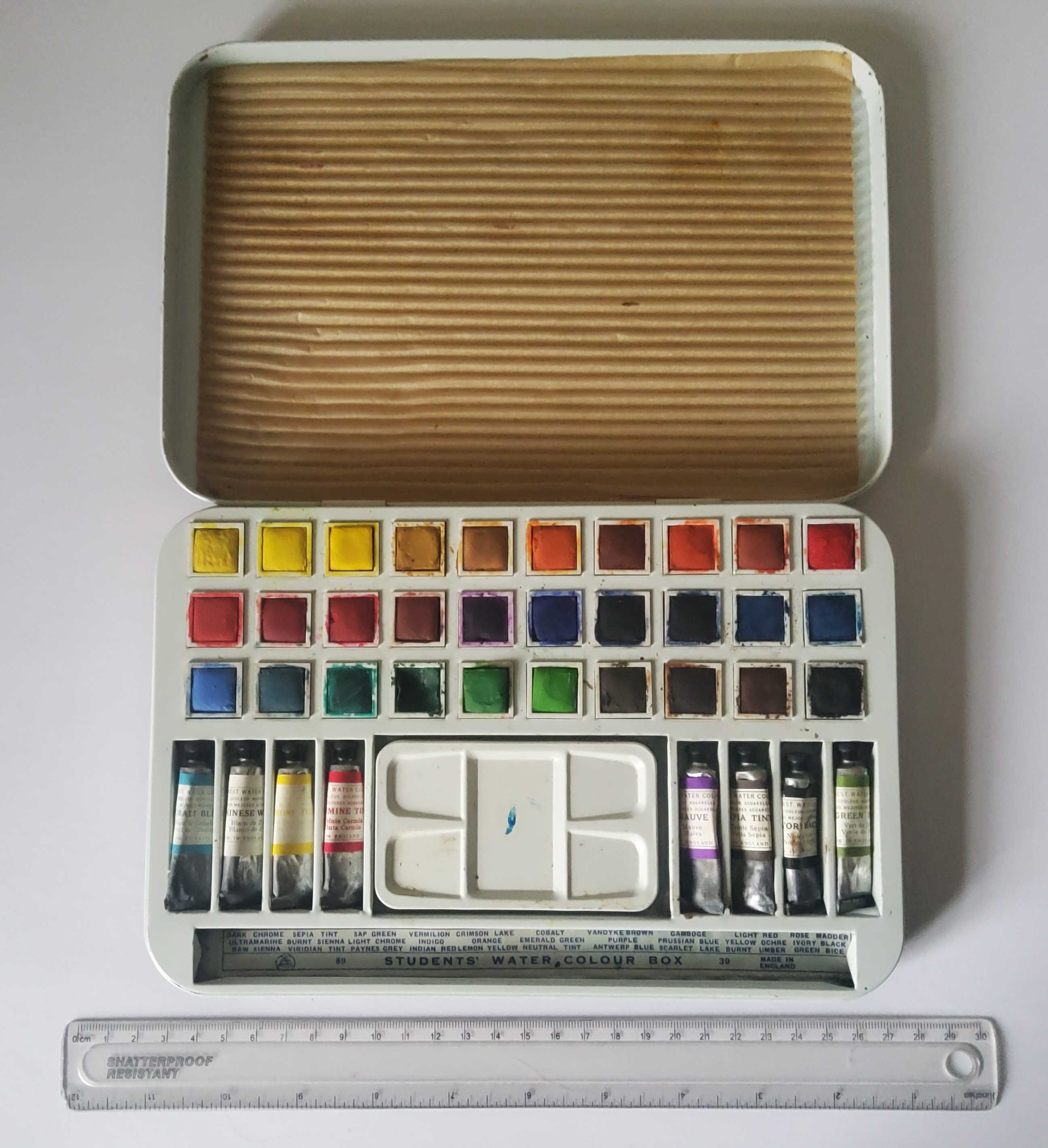
I was recently handed this vintage box of watercolour paint in a lot of “art things” that belonged to a friend of a friend. It looks like they were never used, which makes me sad. I’ve decided to test them out to see if they are still useable.
The set came in a cardboard box, which reads “Page London Students’ colour box made in England.” The Page London logo is embossed in the back of the metal tin as well. Therefore I will assume this is the original packaging.
I’d never even heard of this brand of paint before, so I did a little digging. It looks like the company is no longer producing paint but that they were popular in the 60s and 70s.
Attractive Tins
There seems to be a steady stream of these Page London watercolour sets on Ebay, often with colourful designs printed on the tin. Here is an example of a tin that is up for sale at the time of writing. It has an Alice in Wonderland theme.
Pan paints
The set I have has a plain dark blue tin, possibly intended for a more serious student, instead of a child. Inside are 30 paint blocks, housed in plastic half pans. These pans are square, where modern generic half pans are rectangular. I can drop these Page London pans into a standard paint box, but standard half pans don’t quite fit into this tin.
The colourful children’s sets I’ve seen on Ebay have a serious design flaw, where the paint cakes are glued directly to the tin, suspended on metal tabs with empty space beneath them. Not only do you get less paint, but when the paint cake splits (as it will do when you use it and wear away the middle first) it will fall down between the tabs and get lost. Here’s a picture of the interior of the Alice in Wonderland tin.
Tube Paint
The box I received also contains 8 cute little tubes of paint. Unfortunately the tubes are made of lead, which is quite poisonous.
Astonishingly some the tubes are still soft, I don’t think they were ever opened. I’ve carefully extracted the paint from the tube of Carmine Tint. There’s not enough paint to fill a full pan, but it would probably fill a half pan. When doing this there was a very strong disinfectant smell coming from the paint. This probably explains why it hasn’t gone mouldy even though it is older than I am.
Ignoring the smell, I was pleasantly surprised with how the tube paint performed when I painted a quick swatch. It’s reasonably vibrant, transparent, and flowed nicely off the brush.
I was also able to extract paint from the tube of Green Bice, but the other tubes had hardened. Here’s what the inside of the Cobalt Blue looked like when I opened it.
Not only was the paint dried out, it also seemed to have reacted with the tube. It didn’t seem like a good idea to try to rewet it.
The pans were more frustrating to get going, as they’d dried hard as rocks. I tried leaving them with a drop of water on each one for an hour or so, and they were still totally inert. In the end I took a stiff nylon brush and gave the top of each pan a vigorous scrubbing. This seemed to help initially, but the next day they were back to being rocks.
I noticed after using them that some of the pan colours developed a whitish sediment on the surface…
Here is a sheet with most the colours swatched out. Sorry the colour names are illegible here, but it is a moot point as the colour names were on a slip of paper in a totally random order and I was just guessing at which name relates to which paint.
Paint performance
Maybe hard to rewet paints were in fashion in the era when these paints were made. I found them quite frustrating. I went ahead and did the usual mixing wheel and layering test.
These paints might lend themselves to line and wash style of painting, with light delicate colours. Trying to get a rich masstone was annoying, due to it taking forever to work up enough pigment from the hard cakes, and the resulting colour being difficult to apply evenly.
Test paintings
With these two boxes I was exploring the values available from a single paint. Left, one of the tube paints, and right one of the pans. It was much easier to get rich colour from the tube paint, although the smell made me nauseous, even with a window open. Once dried the thicker applications of paint rubbed off on a finger. The pan paint bound to the paper properly, but you can see it streaking, which is not a problem I usually encounter, even with the Aquafine student quality paint.
The end result seems decent enough, but getting there was a miserable experience. I couldn’t get the values dark enough were I wanted some contrast, what I wanted to be a vibrant sunset dried as high key pastel tones, and trying to apply more layers just lifted and smeared the paint that was already on the page.
Use it or lose it?
This set is a hard pass for me, and I don’t think these paints are worth your time.
I was left with a conundrum of what to do with these. Where I was happy to donate the Aquafine tube set to a local arts and crafts group because the paints were fun to use and non-toxic. So I thought someone else might get a lot of joy out oof them.
Here the paints are frustrating to use, and at minimum the tubes are toxic. Possibly some of the paints too, if the Chrome Yellow colours are made with the genuine pigment and not hues.
I do quite like the sturdy metal tin. It is in good condition, and holds a lot of paint. I decided to use a flat screwdriver to lever the paint cakes out of the pans, scrub them clean, and refill them with artist quality tube paint. The lead tubes and paint cakes went to the local council recycling facility.
Technically the full name of this paint range is Roman Szmal Aquarius, made in Poland, and specialising in pan paints- no tubes as of November 2025. These are professional quality paints, and competitively priced when compared to full pans from many other artist grade paints.
The range has a lot of single pigment paints, including a few unusual ones that may be difficult to find elsewhere. There are over 200 colours available, and I have a selection of 34 at the moment. Whereas my previous reviews looked at curated sets of paint, here I purchased a job lot of somewhat random colours from another artist. Later I bought a half dozen other paints open stock from Jackson’s (not an affiliate link, I just like shopping there) either choosing personal favourites such as Cobalt Blue PB28 or unusual pigments such as Perylene Green deep PBk32.
Colour Selection
Below are swatches of the colours I currently own.
Viridian, PG18. Phthalo Green blue shade, PG7. Perylene Green Deep, PBK32. Olive Green Light, PY129, PY150, PBr25, PB29.
Yellow Ochre, PY43. Dark Ochre, PY43. Cyprus Raw Umber Brownish, PBr7. Cyprus Burnt Umber Deep, PBr7.
Quinacridone Burnt Sienna, PO48. Red Ochre, PR102. Transparent Brown, PBr23. Caput Mortum, PR102.
Shadow Violet, PB29, PG50, Aquarius Grey, PW6:1
General performance
These paints are highly pigmented in every colour I tested. I started testing these paints directly after finishing my Daler-Rowney Aquafine reviews and the difference is striking. A little goes a long way, and I had to consciously back off and use less paint to get the desired results with Roman Szmal’s paints. Excellent!
These are some of the easiest paints to activate amongst every brand I’ve tried. Only M Graham’s paints have been easier to rewet (they don’t really dry out fully, and are always a bit goopy in the pans). The only colour I found difficult to activate was Viridian PG18, which is often a tricky pigment.
When Mr Szmal labels a colour as transparent, he really means it, and there are plenty of them to choose from. With a couple of other brands (notably Blockx) I’d chosen to buy colours specifically because they were labelled as transparent, and was disappointed with how cloudy they were. None of that nonsense here. I really liked the selection of perylene colours available, and have used the perylene maroon PR179 as a substitute for the beautiful but fugitive alizarin crimson PR83.
There is also an array of strongly granulating colours. Potter’s Pink PR233, Cobalt Violet Light PV49, Cobalt Turquoise PB36. Cyprus Raw Umber Brownish PBr7 and Caput Mortum PR102 all create delightful textural effects.
I notice that these paints disperse readily wet in wet, flowing freely across the page. This can make some of the finely divided small pigment paints (phthalos, quinacridones, perylenes etc) a little hard to control, but once they dry they tend to stay in place.
Lightfast Test Results
When I initially got a box of these I cut swatches in half, putting one half on a wall that gets a fair bit of sun and the other in a folder in a drawer. I let them cook for 2 years then compared both halves. The only colour where I noticed a change was shadow violet, which looks slightly less purple after exposure.
Mixing and Layering
I chose 3 transparent single pigment colours for the mixing wheel. They mixed cleanly, with some saturation loss in the purples, probably from using such a greenish blue.
They also layered nicely. This scan is a bit wahsed out, the page much darker and more vibrant in person. The transparent colours get darker as you layer them (as they should) and you can see some of the covering power of naples yellow light and nickel titinate yellow.
One advantage of having a variety of granulating paints, as well as smooth transparent ones, is you can make your own separating mixtures. Similar to “super granuating” convenience mixtures, the heavier granulating pigment settles out and forms a speckled texture within the more freely dispersing pigment. You can also make super granulating mixes by combining multiple granulating paints. Not always easy to control, but can be a fun and easy way to create texture, and a time-saving way to imply detail.
Test Paintings
I have a ton of paintings where I used these in combination with White Nights, but not so many where I only used Roman Szmal. Here’s an adorable unicorn painted with only Roman Szmal Aquaruis for your viewing pleasure.
The next two paintings were completed following tutorials by Geoff Kersey.
And this one was painted from my own photograph:
The paints performed admirably at every turn. I had no trouble getting the depth of value or hue saturation that I wanted. The mixed and layered without getting chalky, shiny, soapy or any other weird thing you might get with substandard paint. The granulating colours were fun to play with, and they even offer a few premixed separating paints, such as shadow violet. I haven’t used shadow violet in these test paintings though, as it changed hue in my lightfast test. All other colours that I tested appear to have great lightfastness.
Verdict
One of the reasons it took me so long to put out this review is because I really like these paints and I didn’t want to switch over to testing the next set. I like them a lot, and I’ll be keeping them to continue using once I’ve tested all the other paints in my silly hoard. I’ve run out of Cobalt Violet Light PV49 though. Its a delightful paint, but weaker than most (normal for this pigment) and I’ve used it to death. RIP.
If you like pan paints I highly recommend these paints. If you prefer tubes these are probably not the paints for you.
Next time I’ll be reviewing a line of student grade paints- Page of London. I was given a vintage set of these recently and I’m curious to see how they handle. See you soon.
Aquafine is a range of watercolour products made by Daler-Rowney. They are cheaper than the Artist’s (professional) range, and more expensive than the Simply (budget) range. They don’t explicitly state that Aquafine are student quality, but logically that’s where they fit in.
The box I’m reviewing today was part of a collection of “art thingies” that belonged to a friend of a friend who sadly passed away recently. The box has some age to it, with the packaging design being outdated. A few of the colours are made from different pigments to those in the current range. It doesn’t look like the previous owner ever actually used the paints.
About the box
I received this set in the original cardboard packaging box above. This has company branding and some basic product information in 5 languages.
Inside is a leaflet with a chart of the full colour range, some basic tips for new painters and two short tutorials.
Of much more interest is the plastic box which actually houses the paints. This has some interesting features I haven’t seen before.
It is quite a substantial box for just 10 colours. There is some company branding on the lid.
Opening things up provides some explanation on why the box is chunky. There are a series of mixing wells in the lid, and two slider wings which pop out of the sides. It’s like one of those transforming robot toys, except paintyer. Yes that’s a word now.
It is worth noting that all these mixing areas are removable, which is a genius idea because it makes them much easier to scrub clean.
I don’t think this particular set is still being produced, but this box design is still being sold. It is now part of Daler-Rowney’s Artist’s watercolour range (sold with a black lid instead of blue), and comes filled with 20 half pans. So if you fancy a box with tons of mixing areas, that option is still out there.
I think the box design has some very good ideas going for it, but not necessarily a good fit for me. Some of the mixing areas were too small to meet my needs, and the plastic stained easily. I just prefer a larger ceramic mixing palette in the studio, and this box is a bit too big and heavy for me to want to travel with it.
The set also comes with a very serviceable number 4 brush. It holds more water and points better than the brush that was included in the travel pan set.
The paints
There are 10 tubes, each containing 8ml of paint. The front has the colour name, permanence and transparency information.
Pigment information is also provided along the side of the tube. On the back is the barcode, company web address, and a little box that says “no health labelling required.” This is good to know if you have kids or pets that might get into ’em.
The colours
Chinese White PW4, PW6
I’m gonna be real, I only used this colour maybe twice. I just don’t reach for white watercolour often, if I want to add white I use gouache instead, because of its greater covering power.
Lemon Yellow PY3
Almost identical to the lemon yellow in the pan set. The fresh tube paint seemed slightly brighter and clearer, but this is probably only because I’ve been using the pan version a lot and contaminated it with other colours.
Vermillion (hue) PR4
This is a pleasing bright warm red with good tinting strength, but PR4 is not lightfast. See technical pigment info here. According to KimCrick’s article here PR4 shows signs of fading in 1-3 months.
NOTE: This colour is now made with PR255, Pyrrole scarlet, which is much more lightfast.
Alizarin Crimson PR83:1
Alizarin crimson is a beautiful cool red, but unfortunately widely reported as fugitive when diluted. In the current Aquafine colour chart and my pan set it has been replaced by PR176, which is more permanent in masstone.
Having no permanent red really put me off this set, it’d have to be confined to sketchbook practice only. Daler-Rowney has clearly done work to correct the issue in recent years, so if you buy a new set of Aquafine paint you should not have this problem.
Ultramarine PB29
A saturated warm blue, I liked this one better than the Ultramarine Blue Deep in the pan set. This definitely has higher chroma, and seems to have stronger tinting strength too. Possibly my favourite colour in the set.
Prussian Blue PB27
A dark cool blue. This one rewet easily, which makes it much better than my Winsor and Newton Cotman tube of Prussian Blue, which dries into an unusable rock.
PB27 is another pigment with questionable lightfastness. To quote KimCrick’s article “Some student brands like Daler Rowney Aquafine, as well as Winsor and Newton Cotman, seem to have unusual texture problems as well as dramatic irreversible fading.”
Viridian (hue) PG7
Phthalocyanine green PG7 (blue shade) is a very reliable cool green. This colour has good tinting strength and painted out well. As usual with phthalo green it is transparent and staining.
Yellow Ochre PY42
Quite similar to the yellow ochre in the pan set, this earth yellow is incredibly useful in situations where the bright cool lemon yellow is too strident.
Burnt Sienna PBr7, PR101
I prefer the new formulation in the pan set, which is a single pigment paint and distinctly more of a orangey brown. This one is more of a chocolate colour.
Ivory Black PBk9
A warm black with good tinting strength. I found this colour dispersed readily, flowing across the page wet in wet. I haven’t used this one all that much, as I find black can sometimes deaden and overwhelm other colours.
Overall I feel that the colour selection isn’t exactly bad, but it isn’t for me. If I remove the 3 fugitive colours, and the black and the white which I don’t have much use for, then I’m only using half the set. The box is specifically moulded to fit the Aquafine watercolour tubes, so I can’t just drop in other brands to substitute colours I’d prefer.
Test paintings
Colour wheel
Mixing lemon yellow, ultramarine blue, and alizarin crimson gave satisfying results.
Layering and Transparency
Colours are generally quite transparent, if a little weak.
Projects
This was done only using colours from the tube set, and a ballpoint pen. The colours mix nicely, I was able to get a skintone without losing luminosity. I used some black on the boot bcause the burnt sienna and ultramarine mix wasn’t going as dark as I wanted.
This one is mostly tube paint, with the addition of raw sienna from the pan set. The paints flowed nicely wet in wet, and lifted easily to create the cigarette smoke. I was able to get some saturated colours- see the yellow staple gun, but overall the painting came out lighter than I had originally intended.
This one is on hotpressed paper, which helps colours look brighter and more vibrant. I had fun with the splashy background, but ended up finishing off some details on the figure with coloured pencils because I couldn’t get the values dark enough and it was just getting dull the more I worked on it.
Use it or lose it?
This set just isn’t for me. Neither the box nor the colour selection are well suited to my needs. However the colours are fairly vibrant, and behave as watercolours should. They flow nicely, and have no weird soapy or chalky texture. There’s loads of paint left and the box is in good working order, so I’ll donate the box to local charity and hope someone picks it up who will enjoy the set and use it.
Aquafine is a range of watercolour products made by Daler-Rowney. The line includes watercolour tube and pan paints, inks, brushes, paper and gouache. Aquafine is Daler-Rowney’s mid-grade watercolour line, they also offer Artists’ professional watercolour, and a basic entry level range called Simply.
What is included in this set
The set comes in a sturdy white plastic case, roughly the same size as a smart phone. The box feels sturdy, and the clasp holds it securely shut, so it won’t flop open in your bag. There is subtle branding, with the Daler Rowney name debossed into the lid. Inside there are 12 half pan watercolours, and a size 4 travel brush. The bush is smaller than what I’d choose, but works fine. The lid has 3 decent sized mixing areas.
There are also small oval wells on either side of the paint pans. I’m not sure what their intended purpose is, but I use them for keeping a small blob of white gouache for creating opaque mixes.
To paint on the go all you’ll need is some water (or a waterbrush) and a sketchbook. Easy.
The packaging shows a picture with the paint tray removed from the box (to make more mixing space) but I’ve only removed the tray once and I don’t recommend it. The fit is really tight and I thought I might break the box getting the paints back in.
The paints are held in individual plastic half pans which can be removed and swapped around. They have the colour names and pigment numbers printed on the side, which is super helpful. I wish more paint makers did this.
Performance
The paints rewet easily and are strong and bright enough to get the job done. Earlier this month I painted a master swatch sheet of every watercolour I own and the primary colours were slightly weaker and more opaque than other brands but the others were all artist quality and most of them are more expensive, sometimes three or even four times the price per ml. The difference in quality is less obvious in the earthtones, which hold their own when compared with much more expensive paints.
Below is a swatch sheet, and a simple colour wheel.
There are four (correctly indicated on the packaging) hue colours here, the Gamboge, Cadmium Red, Alizarin Crimson and Cobalt Blue are all replacements of toxic, fugitive, or expensive pigments.
The colours all painted out well, none of them felt chalky, soapy or gritty, which can all be issues with low quality paint. In general these paints have lower tinting strength than the White Nights line I looked at in the previous post, with the exception of Yellow Ochre, which was pretty good here and disappointingly weak in White Nights.
A look at the individual colours
Lemon Yellow PY3
Lemon yellow is made with Hansa Yellow, and is a good semi-transparent cool yellow.
Gamboge Hue PY155, PR242
Gamboge Hue has rather weak tinting strength and I’ve run out of it. It mixes well despite being a multi pigment paint.
Cadmium Red Hue PR242
A really bright red, and one of the strongest primary colours in the set, More transparent than a genuine cadmium, and mixed well.
Alizarin Crimson Hue PR176
Alizarin Crimson Hue is made from a more permanent pigment than genuine Alizarin Crimson. It is more of a dull pink than a real crimson, but performs well enough as a cool red.
Cobalt Blue Hue PB29, PW6
Cobalt Blue Hue is a bit too warm in my opinion, genuine cobalt blue is a pure primary blue. I was pleasantly surprised that it doesn’t seem terribly chalky, despite containing white pigment.
Ultramarine Blue Dark PB29
Ultramarine Blue Dark is honestly not very dark and I have to use a lot of it to get a strong enough colour. I ran out of this colour during my final test painting.
Hooker’s Green Dark PY3, PG7, PV19
Hooker’s Green Dark is a convenience green (multipigment mixture) which looks a little unnatural. It is quite useful when modified by adding a touch of one of the earth colours to neutralise it slightly.
Yellow Ochre PY42
A nice yellow earth, I’ve been using it as my warm yellow after running out of Gamboge.
Light Red PR101
This earthtone is almost a soft pinnkish colour when diluted, useful for nature studies.
Raw Sienna PBr7
This dull yellowish brown is useful but in my opinion not as impressive as the other earth colours in the set.
Burnt Sienna PR101
I particularly like the burnt sienna as it is transparent, and is effective for mixing neutrals with the ultramarine.
Payne’s Grey PBk7, PB29
Payne’s Grey is nice and strong, and will go dark without appearing chalky, allowing for a full value range
This seems like a well balanced selection of colours, and I was able to mix whatever hues I wanted from what’s included here. I have not run lightfastness tests on these, as they are student grade paints and I’ve mostly used them for quick sketches and studies. The pigments listed above generally have good or excellent lightfastness ratings.
Test paintings
I’ve had this set since it arrived as part of a Scrawlrbox (which probably needs a post of its own) a few years ago, and filled a couple of small sketchbooks with these paints back in 2022. Below are some more recent paintings to refresh my memory of how the paints perform.
While I’ve mostly used these for small sketches I recently did a couple of larger paintings to see how they held up on more finished work. The above image used every colour except Cad Red Hue and Light Red, and the one below used only Cad Red Hue, Alizarin Crimson Hue, Cobalt Blue Hue, Ultramarine Blue Hue, Yellow Ochre, and Burnt Sienna. They were both done following tutorials from Geoff Kersey- *here* is his website. Not sponsored, I just enjoy the tutorials.
The paints handled well, mixing and layering to create finished paintings as good as any other project I’ve done following Geoff’s tutorials. I’m not happy with the sky in the second one, but that’s a problem with painting too slowly and paper drying unevenly, not a fault of the paint. I honestly forgot I was testing this set when doing these paintings, they were very easy to use and didn’t give any significant frustrations.
This last test painting got frustrating getting the colours as dark as I wanted, the space section took 5 layers and started bronzing so I called it done. It also took all the ultramarine I had left in the pan to do it.
Is the set a good choice for you?
I think this set is a good choice if you are new to watercolour and want to get started on a tight budget. The paints are plenty good enough to learn some basics and (more importantly) have fun.
My main issue is that I ran through some colours quite quickly, but you can always refill those most used colours with more potent artist grade paint, buying tubes one at a time as needed.
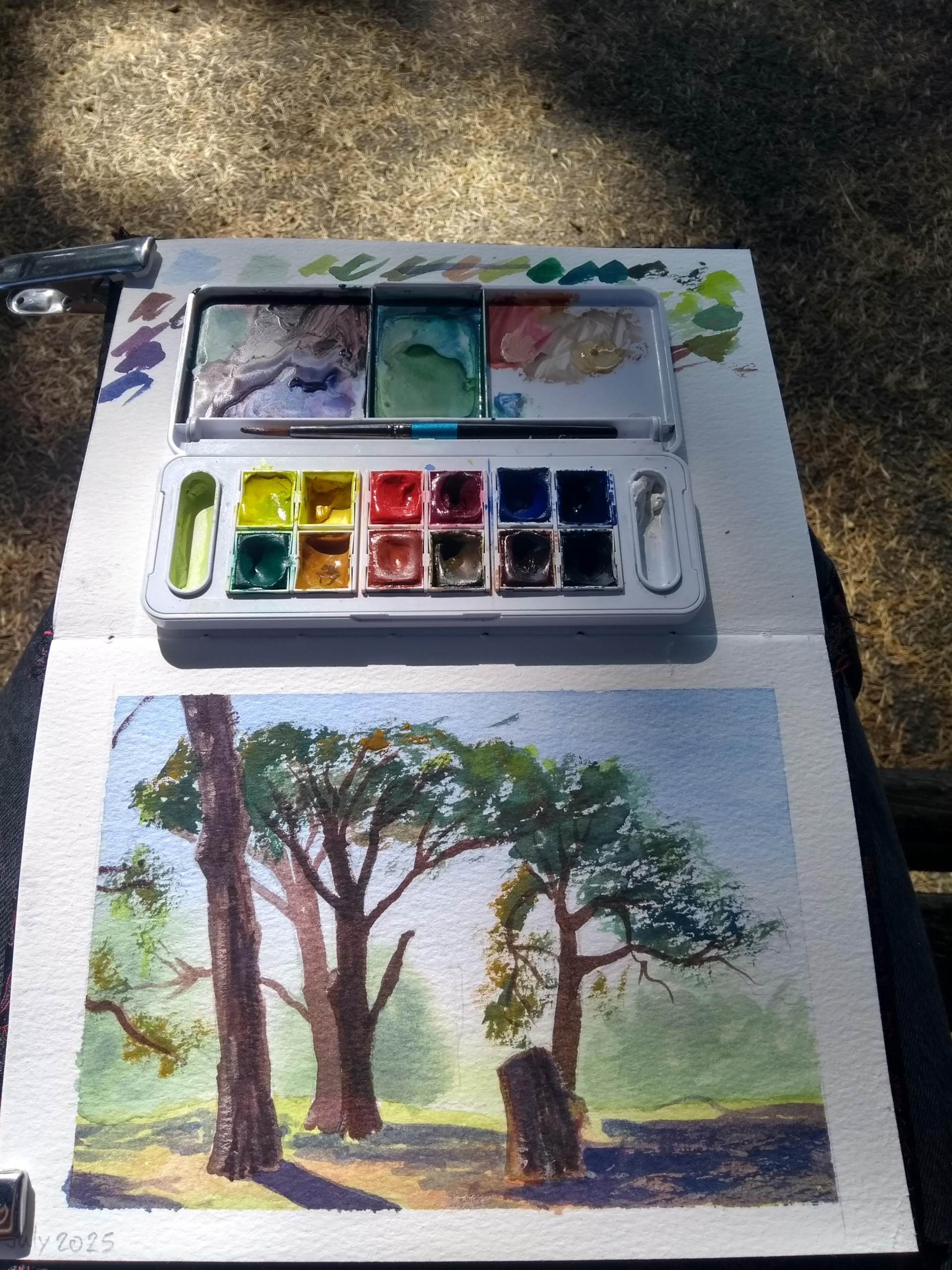
I also think it is a nice set if you’re interested in painting on the go. The box is compact and sturdy, and I had fun painting plein air with it. Of course if you’re an experienced plein air painter you probably already have a setup that’s just how you want it, but as a newbie travel sketcher this box made me happy.
This set is not a great idea if you like to paint BIG. Getting enough colour off the pans gets a bit tedious for anything over A4, especially if you want bold saturated colour and a full value statement.
Use it or lose it?
I’ll be keeping this one, the box is handy and practical, and the choice of colours included is pretty solid. I’m not in love with the paints themselves, so as they run out I’ll be refilling from artist grade tubes instead of replacing with more Aquafine paint.
I purchased this set back in 2021. Before the war in Ukraine. I’m not trying to promote the brand, just provide a source of information. Let’s talk about paint, not politics.
What are White Nights?
White Nights are a series of professional (artist’s) quality watercolour paints made by Nevskaya Palitra in St. Petersburg, Russia. They’ve been produced since the 1930s, but I didn’t hear about them until the late 2010s.
The paints are available in 2.5ml full pans and 10ml tubes, and I will be reviewing the pans. There are 145 colours in the range, about a third of these being newly added in the last 5 years. A lot of the new colours are multi-pigment mixes, in speciality pastel and granulating ranges. I’ll be covering 37 colours from the classic range.
Pricing
I’ve had the set for almost 5 years, and it cost about £45 back in 2021.
The equivalent 36 set is available for just under £80 at https://www.stpetersburgwatercolours.com. While the price has almost doubled in 5 years this still works out at about £2.20 per pan, with a nice sturdy plastic box thrown in.
That’s incredibly good value for a full pan of artist’s quality paint. The only other artist quality range of full pans I know of near this price point is Rosa Gallery.
The set
Packaging
The set comes packaged in this cardboard box, with all information printed in English and Russian. One section is also printed in German, French, Italian and Spanish. The back of the box shows a chart of the included colours, with pigment information. In my set there was no Indanthrene blue, and instead I got Ultramarine Deep. While it would have been nice to try PB60, I was happy that they at least replaced the out of stock colour with another blue, rather than a totally random paint colour.
The box also discloses paint ingredients, listing them as: Pigment, filler, gum arabic, water, additives. While “additives” is a very ambiguous ingredient, I appreciate the transparency of the company providing an ingredient list at all. There are storage instructions which basically tell you not to let them freeze. Also a warning that the set contains zinc dioxide, a guarantee for 5 years from the date of manufacture, and a contact address.
The box
Inside is the plastic box that houses the paint pans, and let me tell you this thing is tough. I am not gentle, as a result, I’ve put the box through the wringer over the last 5 years. The white plastic probably isn’t as bright as it once was but there is no damage whatsoever. The hinge is smooth, the clasp shuts tight, there’s no cracks or dents. I deliberately removed the fold-out mixing tray quite early on, as I prefer to mix on a ceramic palette so it wasn’t useful to me and occupied valuable work space when open.
If you don’t already have a mixing palette then you may appreciate that one is included in the set. There’s also space to store a brush, and you could use the inside of the lid could be used for mixing paint on too.
The pans sit in four recessed rows. Unlike most metal box sets, there are no clips holding them in place. If you want to travel with the set, make sure the mixing flap is in the box, or the paints can be shaken loose and rattle around. Not a big deal, but more than once I forgot to reinstate the flap and then had to put the pans back in their usual order upon arriving on location.
The paints
The pans arrive individually wrapped, with the wrapper giving the colour name, pigment info and a date of manufacture stamp. Also included in the box is a branded colour chart for swatching your colours.
Here is my filled out chart, which fits in the box, although I have it laminated and stuck on my wall as I mostly use the set in the studio, preferring a smaller pocket sized box for travel. Most of the colours are fairly accurate, although it is notable that the cobalt blue does go much darker. At the time of swatching I wasn’t very aware of some pigments having a lower tinting strength than others.
The paints rewet easily, so there’s no need for tedious scrubbing. The paints being full pans also helps with picking up paint easily and helps avoid poking at the paint with the tip of the brush.
In general the paints have good pigmentation, and have lasted a very long time. I’ve been using them as my main workhorse set for years.
White Nights seem to have a bad rep for being fugitive, possibly from older formulations of the paints that haven’t been produced since 2019. I’ve have experienced lightfastness problems in 3 of the colours in this set (less than 10% of the paints) and I’ll talk about them when covering the individual colours below.
With a whopping 36 colours in the set there’s a lot to choose from, and you should be well catered for with whatever you want to paint. As I’ve got more experienced with mixing I find the oranges, purples and greens sit idle these days, but I definitely appreciated the wide colour selection for the first couple of years. There’s plenty of single pigment colours (26/36) and the pigment properties are as you’d expect, cadmiuims are somewhat opaque, phthalos are transparent and staining, ultramarine lifts, and cerulean granulates.
A more in depth look at the colours
Zinc White PW4
Swatch of White Nights watercolour Zinc White
A set this large is probably going to have a white, whether you like it or not. This white is more transparent than the frequently used Chinese white with PW6 and in my opinion is basically useless as a colour. If I want to add white I use gouache, which has better covering power. On occasion I have used this paint to increase the viscosity of a mixture, so it can be dropped onto damp paper without creating cauliflowers, which is pretty niche, but it does serve a purpose. Something I’ve found out more recently is that PW4 can get more more opaque when exposed to light, so that could make mixtures using this paint appear to fade. I haven’t personally experienced this issue as I seldom use this colour.
Cadmium Lemon PY35
A cool, semi-opaque yellow. Useful for adding some vibrant highlights to foliage, and it’s covering power allows for a few touches of light over dark. Can make mixes chalky, I prefer to use it on its own and let the mixing happen on the paper, without fussing with it.
Cadmium Yellow Medium PY35
Another fairly opaque yellow, primary to slightly warm, with good tinting strength. A pleasing colour, though I usually reach for the more transparent “yellow” which I find easier to handle in mixes. The powdery texture does make for interesting mixtures,
Yellow Ochre PY43, PY154
A baffling multiple pigment mix for a usually single pigment colour, this one is disappointingly weak. Yellow Ochre is such a useful colour that I chewed through it pretty quick. I then went on to use use raw sienna as a substitute for this empty colour.
Golden PY3, PO13
A mixture of Hansa Yellow and Benzidine Orange. The orange component has noticeable fading, so the colour appears yellower over time. A brightly saturated orange colour not suitable for works intended for sale or display. Reserve this one for sketchbooking and practice.
Golden Deep PO62
Benzimidazolone Orange produced a similar hue to the Golden colour above, and is more lightfast. I rarely use a bright saturated orange, but when I do, this is the one to go for. I’m not sure why two oranges of almost identical hue were included in the set.
Yellow PY154
Benzimidazolone yellow is a semi transparent primary yellow that mixes great oranges and greens. My go-to yellow, is now sadly empty. Winsor and Newton’s Winsor Yellow is made with the same pigment number, and is very similar in hue and behaviour.
Titan Red PO36
Benzimidazolone scarlet is a reddish orange that when sufficiently diluted makes a wonderful peach colour that is a suitable base for (cartoonish) Caucasian skintones. I relied on this colour for this purpose for quite a while, but a little goes a long way, the pan is still more than half full.
Ruby PR170
Made with Naphthol Red, a pigment known for having variable lightfastness. I haven’t noticed fading in mine, but I don’t know if there might be variation between batches, so this is one to test yourself before using in paintings you want to be archival. A very intense red, and quite pretty. Not one I reach for often, but that’s because there are a lot of reds to choose from in the set, rather than because I dislike it.
Cadmium Red Light PR108
An opaque, warm red. I suspect there is some filler in this one, it doesn’t seem to go as far as the cadmium yellows. If I want a warm red I tend to use Titan Red above, as it goes further and when thinned down is quite transparent.
English Red PR101
A *very* strongly pigmented opaque earth red. I find it tricky to handle because it has a very large drying shift- desaturating significantly as it dries. I think it will make a very useful colour for painting natural subjects if I can pre-empt the colour changing as it dries.
Quinacridone Rose PR122
A very saturated transparent pink with tons of tinting strength. Nice colour for florals, and mixes with ultramarine to make a lovely purple.
Carmine PR19?
I can’t find much info on PR19, and think it might be a typo of the frequently used PV19. Another pink colour, this one is a bit warmer than Quin Rose above, and an excellent cool red for mixing with.
Madder Red Lake Light PR187
Made with an unusual pigment that I can’t find a ton of info on. This transparent colour reminds me of red wine, I’m drawn to it quite a bit. Looking for a substitute for when this runs out, I’ve found perylene maroon, PR179, to be quite similar.
Quinacridone Lilac PV19
A dark, muted purple, with high tinting strength so a little goes a long way. More permanent than the Violet, below.
Violet PV3
My apologies for the bronzing on this swatch, I was not used to such strong colours when I painted these out. A dark, intense purple that is very pretty when freshly painted but goes brownish when exposed to sunlight. Unfortunately one best reserved for the sketchbook, not for professional use.
Here’s the lightfast test result, with 2 years exposure to indoor light on the left, and the control on the right. Even with my poor photography skills, the difference is obvious.
Ultramarine PB29
A common staple of many painters Ultramarine is a saturated, lightfast, warm blue. This one has good pigmentation and subtle granulation.
Bright Blue PB15:3
This is Phthalo Blue, green shade, and is an excellent example. Very very high tinting strength, this one has lasted well despite frequent use.
Cobalt Blue PB28
One of the weaker colours in the set, which would be expected from an expensive pigment with naturally low tinting strength. A very useful primary blue, which got completely used up. This colour had the most pronounced granulation in the whole set, and I had fun using it for textural effects. I bought a pan of cobalt blue from Rosa Gallery to replace it, and it is ever so slightly stronger, and much smoother with little granulation.
Ultramarine Deep PB29
Almost identical to Ultramarine above, but fortunately it is a very useful colour so I don’t see it as a problem. As the name would suggest, this one goes slightly darker at full strength.
Turquoise PB15, PG7
A convenience mix of phthalo blue and phthalo green, strongly staining and transparent. I use this one less frequently than either of its constituents, but it is a pretty colour that behaves itself in mixes.
Indigo PBK7, PB15, PV23
Technically a hue or imitation colour, genuine indigo NB1 is neither lightfast, nor widely available in watercolour paint. A very dark blue masstone, appearing as a cool grey when diluted.
Ceruleum Blue PB35
Presumably a typo of cerulean blue, which is the common name for PB35. A pale pastel blue, lovely for subtle skies.
Yellowish Green PG7, PY3
A bright, saturated green. Looks garish straight from the pan, would want to tone it down by mixing if I intended to paint anything natural-looking. Might suit cartoons or a certain style of illustration work.
Emerald Green PG7
This is phthalo green blue shade and possibly has the highest tinting strength of any paint I own, including those with double the price tag. Absurdly pigmented little box of magic. Not very natural on its own and stains like a b*tch (half my brushes are stained green because of this bad boy) but mixes very well. Mixing this with a transparent red makes a darker tone than the neutral black provided below.
Green G8
Nitroso green is a beautiful dark, natural looking single pigment green, which is unfortunately fugitive when diluted. Stable in masstone, but not worth the risk if you want to display your paintings. I love this colour, and I used it a lot when I first got his set. I used it in a couple of giftcards for my mother, which she loved and displayed. Two years of indirect sunlight later and light washes of this green had almost completely disappeared. Do not make the same mistake I did, reserve this one for the sketchbook.
Lightfast test for Green (PG8) showing fading to the diluted paint on the left card.
Olive Green PG17, PY1, PBK7
A convenience green which I used a fair bit when I was new to watercolours. One of the components, PY1, is less lightfast than the others, and the hue may appear less warm after prolonged exposure to sunlight. Less grievous than the fading in “Green” above, as the paint holds its value (darkness) and takes much longer for any change to be visible. I probably wouldn’t have noticed if I wasn’t specifically *looking* for fading, although the oldest paintings I have done with this are under 5 years old. I’d be comfortable giving someone a card painted with this colour, but not selling the work. If the colour continues to fade over longer periods it could bite you in the arse and damage your reputation as a professional.
Chromium Oxide Green PG17
This military green uses the same pigment commonly used in camouflage paint. An opaque colour, it can make paintings chalky or muddy if used thickly and fussed with. In diluted washes is makes a lovely pale grey green for distant foliage.
Raw Sienna PY43
A yellowish earth tone and one of my go-to colours, especially after I ran out of yellow ochre. This is a little darker and stronger than the yellow ochre, and a single pigment.
Burnt Sienna PBR7
This orangey-red earth tone is easier for me to paint with than the English red above, as it has a much smaller drying shift. Semi-transparent and non staining, a valuable mixing colour.
Umber PY43, PBR7, PBK7
Umber is often created with a single pigment so this multi pigment mixture is a little baffling. A cool, almost greenish brown, I used it a lot when I first got the set as it goes quite dark and cool dark browns can be hard to mix.
Burnt Umber PBR7
The colour of milk chocolate. I prefer burnt sienna for my warm earth tone, but there’s nothing to complain about with this colour either.
Mars Brown PBR6
A transparent version of a traditionally opaque pigment. A granulating mid brown.
Sepia PR102, PBK7, PR187
The darkest brown in the set. Sepia was originally made in the 18th century from the ink sacks of cuttlefish, it is now made from a mixture of pigments. Since I learned to mix a dark brown from burnt sienna and ultramarine I use this paint less frequently, but still a nice colour to have available.
Neutral Black PR187, PB15, PBK7
What it says on the tin. A premixed neutral black, all ready to go.
Paynes Grey PBK7, PB15, PV23
This goes just as dark as the black next door, but has a cooler tone. Less noticeably blue than the other payne’s grey paints I have (from M Graham and Daler Rowney) this pan is now empty, as I used the colour for dozens of value studies.
(bonus) Irgazin Yellow PY129
Purchased open stock on a whim shortly after obtaining the set, this single pigment green gold colour is transparent and staining. Green in masstone and yellow when diluted, its a very interesting colour. I like it for foliage.
Technical testing
Below is a colour wheel test, to show the results of mixing 3 primaries. If I still had any “yellow” (PY154) left I would have chosen it for this exercise, but was pleasantly surprised by the Cadmuim Yellow I was forced to use instead. The greens it mixed aren’t quite as bright, but it creates an interesting subtle texture where it wanted to separate out from the blue (phthalo PB15).
With the wet in wet mixed bars on the second half I tried out a couple of different primaries. Swapping the phthalo blue for ultramarine gave more vibrant purples, but dull olive greens.
Also shown are a number of the colours layered over one another. This shows which paints are more opaque vs transparent. To a lesser extent is shows whether the colour applied first reactivates and lifts when a single paint stroke is gently applied over it. You can see that the chromium oxide green is very opaque, and the emerald (phthalo PG7) is much more transparent.
Completed paintings and projects
Regardless of whether you like what I chose to paint, there’s no denying that these paints can create a full range of hues and values.
Key strengths and weaknesses
Pros
Paints offer a lot of bang for your buck. The quality of paint for the price is kind of a steal, I like these better than Daler Rowney Aquafine- a good student quality line in the same price range. Rosa Gallery is similar in price but I’ve only tried one colour so it would be unfair to extrapolate the entire range from one pan. Some of the colours hold their own compared to much more expensive examples of the same colours from other brands.
Most colours are well pigmented. The Phthalo based colours in particular are incredibly strong.
Paints come in a very durable box. It’s a bit to big and bulky to make a nice travel set, but that’s not what the box is marketed as, or what I bought it for.
The labelling is clear, with pigment information provided on both the box and the individual pan wrappers. There are a couple of possible typos with the PR19 and Ceruleam but it doesn’t feel like information is being deliberately obfuscated. Colour names are sensible, with names such as cad red light, quin rose and cobalt blue directly indicating the actual pigments they contain rather than some fanciful marketing BS names like “Christmas tree green.”
Individual pigment characteristics are apparent, but not obtrusive. This puts them in a goldilocks zone between some brands who seem to deliberately try to mill all pigments to the same particle size so all colours behave consistently, and others where certain colours granulate so aggressively you can feel like a spectator in your own paintings as they do their own thing.
The majority of the paints are single pigment, making mixing a doddle. Most of the multipigment paints are either convenience greens, or modern substitutes for antiquated colours, like sepia.
Cons:
3 of the colours have significant lightfastness problems and are not suitable for paintings that will be displayed. Keep in mind that a *lot* of artist quality paint ranges offer Opera Rose (which includes a fugitive neon dye), Aureolin PY40 (which often acquires brown discolouration), and genuine Alizarin Crimson PR83 (well documented to be less stable than modern alternatives) and this does nothing to harm their company’s reputation whatsoever. If you only want lightfast paints you could ditch the 3 problem colours and still have a large, well balanced set of colours for a bargain price. My actual beef over this is that Golden and Green get 2 out of 3 stars for lightfastness on the packaging and they undergo very significant changes within 1 year of display. I don’t have a problem with fugitive artist grade paints being made and sold- as long as they are clearly labelled as such.
There are quite a few opaque colours here, and that’s something I know some watercolourists hate. I don’t think opacity is necessarily a bad thing- I like a dab of lemon for a quick pop of highlight on foliage- but it is more about knowing your paint properties and using them accordingly.
The pans are slightly smaller than standard full pans, at 2.5ml instead of 3. While this doesn’t negate the set being excellent value for money, it does mean that you can’t substitute full pans from other brands into the box- they’re too big to fit. You could refill the empty 2.5ml pans from tubes to work around the issue.
The yellow ochre is frustratingly weak, which is a bit of a let down for such a useful colour that other student paint lines often do well with.
Using a 3 pigment mix to make umber is baffling, and the only logical explanation I can think of is that this was a cost cutting measure.
The current standard 12 pan offering contains the aforementioned disappointing yellow ochre, multipigment umber, and the fugitive green. It also features the 3 cadmium colours which are lovely paints but the opacity can be challenging. If you just want to try a few colours you might be better off picking them open stock, if you can find them.
If buying second hand, make sure you check how old the set is. This set contained more fugitive pigments Prior to 2019-2020.
With current distribution issues, the pricing of vendors is all over the place. Look for deals that still offer these around the £2 per pan mark. If the listing works out at £4 per pan or more look elsewhere. If you have a bit more cash to splash and like full pans Roman Szmal are *lovely* paints and their cheaper series start at around £5 per pan.
Use it or lose it?
This one lands firmly in the use it pile. I have been using it, to the point that a fifth of the pans are now empty. Because I’ve run out of a few of my most frequently used colours I’ll probably be using this in conjunction with other paints to fill in the gaps, but it isn’t leaving any time soon.