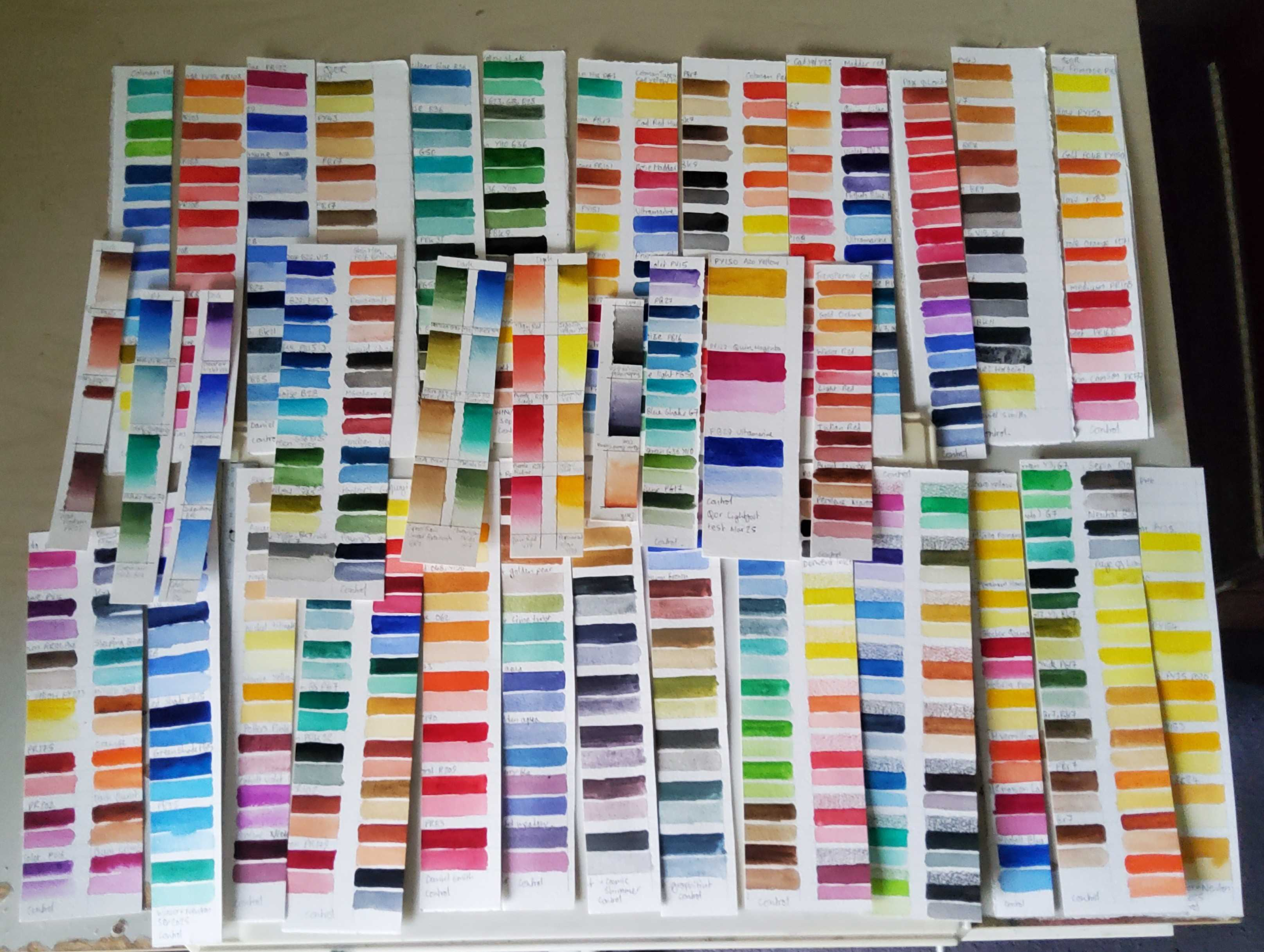
Yes, that’s what I’ve been doing for the past three weeks.
What does lightfast mean?
A lightfast substance resists fading when exposed to sunlight (or UV radiation) over a period of time. Lightfastness is not a binary system, but a sliding scale. Some paints fade quickly, while others more slowly. Some are so lightfast that we can’t perceive any changes within a human lifespan.
Paints which fade quickly are often referred to as fugitive. Paints which do not fade (or take a very long time to fade) are sometimes called permanent, although permanence would include other factors such as resistance to humidity, temperature and acidity.
Industry standards
The two most common measuring systems are The Blue Wool Scale and ATSM (American Standard Test Measure).
Blue Wool Scale scores paints from 1 to 8. 1 is rated as poorest, fading in less than 2 years in “normal lighting conditions.” 8 is the most lightfast, and should be okay to display for 100 years or more in normal lighting conditions. According to Wikipedia normal lighting conditions are defined as “Away from a window, under indirect sunlight and properly framed behind a UV protective glass.”
ATSM rates paints between I-V. These are in the opposite order to BWS, with I being the most lightfast and V being the most fugitive. V is equal to 1 on the BWS, IV to 2-3, III to 4-5, II to 6, and I to 7-8.
Paint manufacturers may also do their own tests, and categorise paints on a totally different scale. Common ones are rating paints out of three stars, or four. You’d have to find out from each individual brand what their star ratings mean.
Does lightfasntess matter?
Yes, and no. It depends what you want to do with your paintings.
If you’re going to display of sell your original paintings it absolutely does matter. Even if you’re framing them, and even if they’re not being displayed in a particularly sunny spot.
In the past I’ve given paintings to family and friends. I remember being horrified when I went to visit a friend a couple of years later and the hues of one of my paintings were no longer at all what I had originally painted. The blues, greens and blacks appeared way more dominant, as some of the other colours had partially faded away.
It’s one thing to be personally embarrassed by a faded painting that had been a gift, but if that painting had been sold as professional work it would probably anger the customer and undermine the artist’s reputation.
On the other hand, if you only paint in a sketchbook for your own pleasure, or scan/photograph your work to sell as prints, then the lightfastness of your paints is not relevant.
Problems with lightfastness ratings on watercolours
- Some companies rely on their own tests or unorthodox rating systems. Finding out what their stars are supposed to correspond to, or how the paints were tested, can be difficult or impossible.
- Some paint manufacturers rely on generic tests done on the pigments, rather than the actual paints they make. Some pigments vary in quality and lightfastness from different suppliers, or even different batches from the same supplier.
- Most paints are tested in masstone (full strength only) but watercolour is often used very diluted to create transparent washes. Some pigments are far more stable at higher concentrations. This has led to cases of a paint being given a top lightfast rating, but fading dramatically in watercolour. For example see Kim Crick’s findings on PO64.
So what can we do about it?
One strategy is to stick to pigments that have been around for a long time and reliably come out with great lightfast ratings. For example PBr7 has been in use a long time and widely reported as durable.
Another is to research tests done independently by other artists. Handprint is an incredibly valuable and detailed resource, although some information is gradually becoming out of date as paintmakers update their formulations and new brands enter the market. Kim Crick does fantastic and rigorous tests on watercolour paint, as do many others, if you look around.
The most definitive way to know how the specific paints you own will perform is to test them yourself. Which is how I’ve found myself with a mountain of 300+ paint swatches.

A few of these were done a while ago. The gradated swatches of Roman Szmal paints have been on display for 2 years. I’ll share my findings in the upcoming review of those paints, which should come out this week.
Most of them are painted fresh, and have already been cut in half, one half as a control which is going in a box in a drawer, well away from light exposure. Before I put the exposure strips up, I’m just waiting for my official blue wool test scale to arrive.
My older tests were just pinned to a sunny part of a wall for a year (or 2) and the paints that didn’t fade got a “well I guess this is fine” from me, but I want to be more accurate with the tests I do from now on. Using an official test strip will let me know when my paints have received enough light exposure to pass for a specific BWS rating.
I need to use my window as a goddam window, so my tests are on a sunny indoor wall instead. I expect this will cause my experiments to take much longer than a standard test.
All the new swatches are painted on the same paper- Winsor and Newton’s professional cold press. So there shouldn’t be any yellowing of the paper to throw the test results off.
I’ve prepared tests for almost every colour I own. I’ve ommited some whites because I don’t think I’d be able to asses changes in white paint on white paper very well, and I seldom use white watercolour anyway. I haven’t tested the Kuretake granulating colours, but you can see how they did in Soo’s video here.
Almost all colours have been painted in two stripes, one at masstone, and one in a more diluted wash. I did this by eye, without measuring the ammount of water I added to each mix precisely, so it won’t be the most scientific test. I still think this is much better than only testing the masstone. I’ve done a single strip for the Cosmic Shimmer paints, because they need to be applied quite thickly to get the sparkle effect to work.
I’m also testing my Derwent Inktense pencils here, as I like them a lot but Derwent’s lightfast ratings are only accurate for the pencils when applied dry. I want to see how they do when activated with water, because that is primarily how I use them. These have 3 strips, one dry, one where the pencil was applied to the paper and activated with water, and one which was painted directly as a more diluted wash.
Once I have the test scale arrives I’ll set them cooking and check them once a week by eye. As each blue wool strip fades I’ll report back with any paints that also show fading. These test results won’t be be purely based on light, the paints are also being subjected to background air pollution (I live on a busy main road) and the changes in temperature and humidity of a fairly typical UK home.
I think that’s it for now. I’ll be back with that Roman Szmal review soon. Toodles.