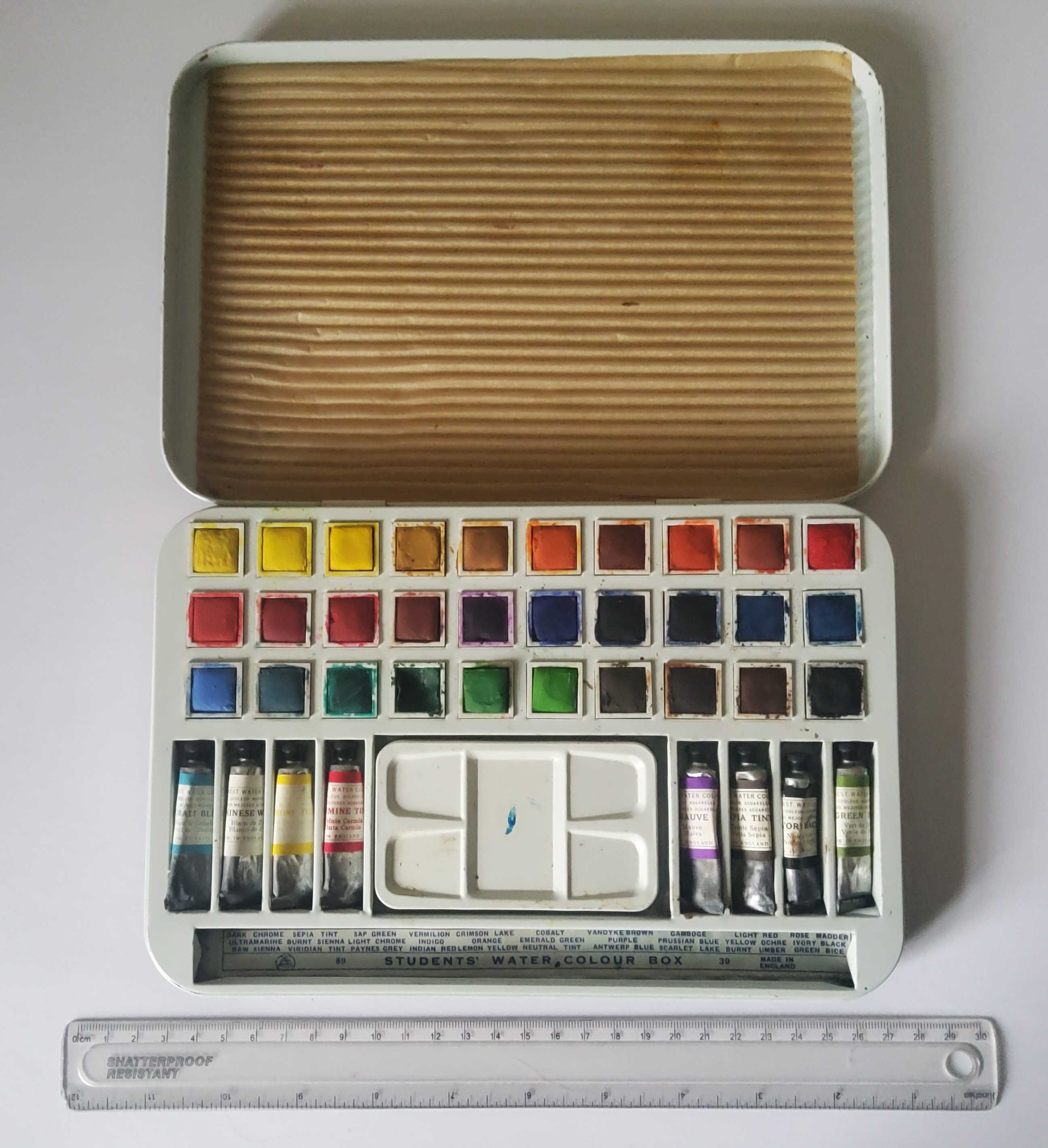
I was recently handed this vintage box of watercolour paint in a lot of “art things” that belonged to a friend of a friend. It looks like they were never used, which makes me sad. I’ve decided to test them out to see if they are still useable.

The set came in a cardboard box, which reads “Page London Students’ colour box made in England.” The Page London logo is embossed in the back of the metal tin as well. Therefore I will assume this is the original packaging.

I’d never even heard of this brand of paint before, so I did a little digging. It looks like the company is no longer producing paint but that they were popular in the 60s and 70s.

Attractive Tins
There seems to be a steady stream of these Page London watercolour sets on Ebay, often with colourful designs printed on the tin. Here is an example of a tin that is up for sale at the time of writing. It has an Alice in Wonderland theme.

Pan paints
The set I have has a plain dark blue tin, possibly intended for a more serious student, instead of a child. Inside are 30 paint blocks, housed in plastic half pans. These pans are square, where modern generic half pans are rectangular. I can drop these Page London pans into a standard paint box, but standard half pans don’t quite fit into this tin.

The colourful children’s sets I’ve seen on Ebay have a serious design flaw, where the paint cakes are glued directly to the tin, suspended on metal tabs with empty space beneath them. Not only do you get less paint, but when the paint cake splits (as it will do when you use it and wear away the middle first) it will fall down between the tabs and get lost. Here’s a picture of the interior of the Alice in Wonderland tin.

Tube Paint
The box I received also contains 8 cute little tubes of paint. Unfortunately the tubes are made of lead, which is quite poisonous.

Astonishingly some the tubes are still soft, I don’t think they were ever opened. I’ve carefully extracted the paint from the tube of Carmine Tint. There’s not enough paint to fill a full pan, but it would probably fill a half pan. When doing this there was a very strong disinfectant smell coming from the paint. This probably explains why it hasn’t gone mouldy even though it is older than I am.
Ignoring the smell, I was pleasantly surprised with how the tube paint performed when I painted a quick swatch. It’s reasonably vibrant, transparent, and flowed nicely off the brush.
I was also able to extract paint from the tube of Green Bice, but the other tubes had hardened. Here’s what the inside of the Cobalt Blue looked like when I opened it.

Not only was the paint dried out, it also seemed to have reacted with the tube. It didn’t seem like a good idea to try to rewet it.
The pans were more frustrating to get going, as they’d dried hard as rocks. I tried leaving them with a drop of water on each one for an hour or so, and they were still totally inert. In the end I took a stiff nylon brush and gave the top of each pan a vigorous scrubbing. This seemed to help initially, but the next day they were back to being rocks.
I noticed after using them that some of the pan colours developed a whitish sediment on the surface…

Here is a sheet with most the colours swatched out. Sorry the colour names are illegible here, but it is a moot point as the colour names were on a slip of paper in a totally random order and I was just guessing at which name relates to which paint.

Paint performance
Maybe hard to rewet paints were in fashion in the era when these paints were made. I found them quite frustrating. I went ahead and did the usual mixing wheel and layering test.


These paints might lend themselves to line and wash style of painting, with light delicate colours. Trying to get a rich masstone was annoying, due to it taking forever to work up enough pigment from the hard cakes, and the resulting colour being difficult to apply evenly.
Test paintings

With these two boxes I was exploring the values available from a single paint. Left, one of the tube paints, and right one of the pans. It was much easier to get rich colour from the tube paint, although the smell made me nauseous, even with a window open. Once dried the thicker applications of paint rubbed off on a finger. The pan paint bound to the paper properly, but you can see it streaking, which is not a problem I usually encounter, even with the Aquafine student quality paint.
I managed to make one finished painting with these, following one of Geoff Kersey’s landscape tutorials.

The end result seems decent enough, but getting there was a miserable experience. I couldn’t get the values dark enough were I wanted some contrast, what I wanted to be a vibrant sunset dried as high key pastel tones, and trying to apply more layers just lifted and smeared the paint that was already on the page.
Use it or lose it?
This set is a hard pass for me, and I don’t think these paints are worth your time.
I was left with a conundrum of what to do with these. Where I was happy to donate the Aquafine tube set to a local arts and crafts group because the paints were fun to use and non-toxic. So I thought someone else might get a lot of joy out oof them.
Here the paints are frustrating to use, and at minimum the tubes are toxic. Possibly some of the paints too, if the Chrome Yellow colours are made with the genuine pigment and not hues.
I do quite like the sturdy metal tin. It is in good condition, and holds a lot of paint. I decided to use a flat screwdriver to lever the paint cakes out of the pans, scrub them clean, and refill them with artist quality tube paint. The lead tubes and paint cakes went to the local council recycling facility.
Leave a Reply